 |
| Ludger Berges' Hopfen & Malz shop in Berlin-Wedding. (Photo: Philip Husemann) |
"Berlin was waiting for good beer" – this was shop owner Ludger Berges' reply upon being asked why he decided to open his Berlin-Wedding beer shop Hopfen & Malz in February 2012. Before exiting the pharmaceutical industry that was failing to float Berges proverbial boat, he began researching the German beer market and sifting out the best brews across the country (see Aktion Gutes Bier). Today, his shop carries about 300 different brews, and his selection mainly comes from within Germany, but he also stocks beers from the U.S., Belgium and a few other countries. I think the above quote from Mr. Berges – and the success of his shop – is symbolic of a nascent change going on in Berlin's (and maybe Germany's) beer world. I think it's also a development that has the potential to affect all stages of the life cycle of German beer – how it's produced, distributed, sold and consumed. Much like the United States during the mid-20th century, the German beer market has seen a consolidation and monopolization of the beer production, distribution and sales processes, resulting in less variety, less choice, and less quality in a country where beer is a cultural – and of course a nutritional – staple. The question: Can Germany reverse this development and rediscover the great variety that's always been present in its beer culture? And perhaps more importantly, how?
The U.S. Beer Renaissance
I'd like to start by having a look at how America's beer world has changed, and is changing. The number of breweries in the U.S. steadily declined well into the 1980s as conglomerates swallowed up smaller brewers, which resulted in a boring beer "monoculture" – beer drinkers basically had the choice between regular or light lagers (Miller/Miller Lite; Bud/Bud Light; Coors/Coors Light, Busch/Busch Light etc.). A more apt description of this choice: high-calorie dishwater versus low-calorie dishwater. In the late 1970s, the number of breweries bottomed out at 89 nationwide, which had a number of fundamental effects on beer culture and business in the U.S., many of which persist today:
1. The business of brewing is only about the bottom line, and quality inevitably suffers:
For example, Anheuser-Busch InBev (A-B InBev) brews with cheaper grains (such as rice) to save money, and fewer or poor quality hops are used because the plant is expensive. Much more recently, A-B InBev has been fighting claims they've been watering down their beer to save money. The way I see it, it makes zero difference whether they watered their beer down or not; their beer still tastes like rubbish (or in the best case, nothing) to anyone who knows anything about beer, and it's because all they really care about is a better bottom line and a growing market share.
2. Brewing conglomerates move to control distribution and shelf space in stores:
This issue is crucial, and as we shall see, it's also crucial in Germany's beer market. As in any business, more market share means more control over the means of distribution, and it also means you can impose more pressure on the retailers to prominently display your product. In Beer Wars, a 2009 documentary about the beer business in the U.S., we learn about the so-called three-tier system in the U.S. (Brewers, Distributors, Retailers), which successfully helps to curb vertical integration, which allows the corporation to control all stages of production. But in doing so, the three-tier system actually encourages horizontal integration (acquisition of, and/or merging with competitors to form huge conglomerates). In short, the big boys can muscle out the runts by: a.) getting distributors to not deliver for the competitor, and b.) providing retailers with dozens of 'brands', thus occupying more and more shelf space (Check out this fantastic overview from the Washingtonian).
3. An ignorant consumer is a good consumer for the brewing juggernauts:
In creating a beer market where there is little difference between competitors' products, the battle is shifted away from the arena of product quality toward the marketing arena, and this is exactly where the big fellas want to fight their war (A-B InBev spent $1.42 billion in 2011). If consumers spend their lives in a market dominated by boring swill, they'll be less likely to notice or develop a taste for a higher quality product if it does manage to enter the market.
Here's the good news: Americans are developing a taste for higher quality beers and a more diverse product; the result is more choice for the consumer, the emergence of American brewers as some of the best in the world, and a "democratization" of the beer-brewing market. As Herr Berges at Hopfen und Malz informed me, home-brewing was actually not even legal in the U.S. until Jimmy Carter legalized it in 1979 (it still isn't legal in Alabama, and will finally be legal in Mississippi as of this summer), and if you cast another glance up to the Brewer's Association chart, it's no coincidence that this legalization lines up nicely with the explosion of craft breweries after 1980. Today, there are over a million homebrewers in the U.S. and over a thousand homebrew clubs. In the past decade, new U.S. breweries have consistently competed at the World Beer Awards, and often won, against the "traditional" country of origin for a given beer type. Since 1980, over 2,000 new craft breweries have been established, and although the U.S. beer market overall is declining – a development that is now mirrored in Germany – craft breweries producing fewer than 700,000 L per year saw a robust 13% increase in sales (U.S. Brewer's Association). As shown in this NPR piece, they continue to chip away at their total share of the market. All stats aside, I think the development of the American beer market is part of a more general and growing movement of buying local, avoiding chains and conglomerates, and being more aware of the source of one's food and drink. Although craft brewers still only account for a small fraction of the overall market, they've succeeded in greatly widening the horizons of beer drinkers in the states and reminding people what beer can and should taste like.
(Update: I was unaware of this recent story from BBC about how the British beer scene has been influenced by America's craft beer boom.
A Similar Story in Germany – with a similar outcome?
When I sat down to talk with Hopfen und Malz owner Mr. Berges last month, I was curious if the state or development of the German beer market in any way resembled that of the U.S. I was vaguely aware of a similar consolidation of brewers in Germany (i.e. that Becks, Spaten and several other big German names had been snapped up by InBev back in the day, and German companies responded in kind), but I had no idea how similar the picture actually looked...
Mr. Berges discovered the true variety of German beer in the same place I did: in the rolling hills of the east central region of Franken (Franconia). This area boasts the densest collection of breweries in the world, with nearly 300 of Germany's 1,400 or so breweries. Berges assured me when I listed the breweries we had visited on our beer/bike tour that we had missed the best place in all of Germany to drink a beer: the Schwarzer Keller in Weigelshofen. Most of Franconia's breweries are located in small towns, and are small-production Privatbrauereien with long histories. Helles, Dunkles, Kellerbier, and Rauchbier are the leading varieties in Franken. But Germany's beer diversity isn't just robust in Franconia: there are hundreds more small breweries from Bavaria in the south, to the Danish border in the north, where some of the world's best pilseners, Weizens, and Kölschs in the world are made. So why is it that so many of us beer-lovers – despite our appreciation for the superiority of the German Pils and Weizen – find ourselves growing bored in a country with so much good beer? Three words, according to Mr. Berges: "Distribution, distribution, distribution"...
Why German Beer is so Damned Cheap
Much like the U.S. companies, German brewing companies began swallowing up smaller breweries one by one in order to gain more market share. The largest brewery in Germany, the Radeberger Group, owns some 40 different brands and controls about 15% of the beer market by itself. A company called Brau Holdings International (BHI) and AB-InBev round out the top three. Though it's perhaps not as extreme as in the U.S. in the 1980s, the top 8 companies in Germany controlled 52% of the market in 2009 (see Aktion Gutes Bier).
But here's the real kicker: Germany doesn't have a three-tier system to stop these conglomerates from vertically integrating, and thus controlling all steps in the process. For example, the Radeberger Group brews the beer from its 35+ brands, distributes them, and then sells them in warehouse-like Getränkeläden or Märkte (drink stores – see also my earlier post "Into the Drink"). This kind of vertical and horizontal integration has the positive effect of reduced production and distribution costs, such that beer is quite a bit cheaper than most water in Germany. I always thought it was just because Germany likes beer more than a friend, but it's really all about capitalism: the conglomerates can produce, distribute and sell beer extremely cheaply while still profiting, and want to keep it cheap, but not too cheap (either legally, or illegally by means of price collusion) to maintain their dominance. The end result, as Mr. Berges put it: "If you go to Getraenke Hoffmann (owned by Radeberger Group), they have 200 Getränkemärkte in Berlin and Brandenburg. And they all belong to this [Radeberger] Group. So if you go there and look at the variety, 50% comes from the same brewery. You do not see it because of all the different labels, the colors of the boxes, but it's all the same company...that is why people think it all tastes the same." The real clever bit on the part of the conglomerates was keeping all the regional labels they had swallowed up so that the vast majority of consumers would remain ignorant to the fact that all the variety is in fact illusory. I imagine most have no idea that their beloved local brand they grew up with has been bought out by a multinational corporation. In cities like Berlin, this means that the hundreds of small Spätis (convenience stores) can source all of their beer from two or three distributors (i.e. Radeberger, AB-InBev and BHI) and still offer what appears to be a wide selection of beers for rock-bottom prices. And the same goes for the supermarkets.
The Plight of the Beer-Lover's Beer Shop in Germany, and the Light at the End of the Tunnel
So because of all of this, as Mr. Berges explained, "Germans have only three major sources from which to buy beer: the Getränkemarkt, Supermarkt, and the Kiosk/Späti, and none of them focus on small-production brewers." This of course was the impetus for Berges' Hopfen und Malz, but unlike liquor stores in the States, he has no easy method of getting beer to his store. He had to laboriously establish personal contact with dozens of breweries and distributors one by one, and currently works with 30 (!) different distributors in order to maintain his current stock. He focuses only on the top-rated smaller suppliers and displays them clearly by beer type, the best of the best residing at eye level. It's a refreshing new way to experience and shop the Vielfalt (diversity) of German beers. But Berges doesn't just carry the traditional German beer types from Franconia and Bavaria: he also stocks the newest pilsners, porters, and yes, IPAs, APAs, and XPAs (!) from Germany's newest microbrews, which are popping up at an increasing rate all over Germany.
So despite all of the aforementioned factors working against them, these new microbrews and brewpubs are beginning to breathe new life into the German beer market. Berlin now has 20 breweries and brew pubs, only 1 of which is large-production (unsurprisingly owned by Radeberger Group). Berges believes this number will grow to 30-40 in a few years, including the first American-owned brewery to open in 2013, called Vagabund-Brauerei. Founders Tom, Matt and David started as humble home-brewers, but are now crafting a set of ambitious beers in hopes of broadening German beer taste and bringing some much-needed variety to Berlin's beer market. It's interesting that the homebrewing craze that helped kick-start the U.S. microbrew market is not quite as prominent in Germany (Berges reckons there are somewhere in the neighborhood of 10,000 people who are homebrewing in Germany); one of my theories is that even the mass-produced pilseners are still top-quality products compared to the Buds and Millers of the U.S., so perhaps there was less impetus for exploration. But maybe it was also just that something that was long forbidden in the U.S. had suddenly become legal, so people went hog-wild on it.
In the end, it's clear to me that there are two big keys to Germany (re)discovering the quality and variety of it's brewers: until shop owners like Berges have a less burdensome method of stocking products from quality, small-production breweries, they will remain needles in the haystack of Spätis, Getränkemärkte, and Supermärkte. The big players will definitely fight this tooth and nail, but I think craft brewers in the States and the new ones cropping up in Germany have shown that if you brew it, they will come. However, I think the demand side might be even more important: The German consumer must wake up, smell the hops, and realize that they've been duped by the beer behemoths. Nobody expects the majority to drop everything and never buy an AB-InBev beer again, but some of the energy Germans put into buying organic foods can certainly be shifted over to more conscientious beer shopping. Hopefully they can also overcome their often rigidly traditional mindsets to explore some of the plethora of wonderful beer types that didn't originate in or near Germany. I, for one, am optimistic.
(If you'd like to travel back in time to beer's past, have a look at Part 1. Also, another big thanks to Ludger Berges and Hopfen und Malz for his insight into this blog post. Also, if you're interested in getting updates on the newest promising pilsners, pale ales, and porters in Germany and beyond, the Hopfen und Malz Facebook feed is a great resource!)
The U.S. Beer Renaissance
I'd like to start by having a look at how America's beer world has changed, and is changing. The number of breweries in the U.S. steadily declined well into the 1980s as conglomerates swallowed up smaller brewers, which resulted in a boring beer "monoculture" – beer drinkers basically had the choice between regular or light lagers (Miller/Miller Lite; Bud/Bud Light; Coors/Coors Light, Busch/Busch Light etc.). A more apt description of this choice: high-calorie dishwater versus low-calorie dishwater. In the late 1970s, the number of breweries bottomed out at 89 nationwide, which had a number of fundamental effects on beer culture and business in the U.S., many of which persist today:
1. The business of brewing is only about the bottom line, and quality inevitably suffers:
For example, Anheuser-Busch InBev (A-B InBev) brews with cheaper grains (such as rice) to save money, and fewer or poor quality hops are used because the plant is expensive. Much more recently, A-B InBev has been fighting claims they've been watering down their beer to save money. The way I see it, it makes zero difference whether they watered their beer down or not; their beer still tastes like rubbish (or in the best case, nothing) to anyone who knows anything about beer, and it's because all they really care about is a better bottom line and a growing market share.
2. Brewing conglomerates move to control distribution and shelf space in stores:
 |
| The American brewery 'pinch' in the 70s, and the subsequent explosion of microbrews. (Graphic: Brewer's Association) |
3. An ignorant consumer is a good consumer for the brewing juggernauts:
In creating a beer market where there is little difference between competitors' products, the battle is shifted away from the arena of product quality toward the marketing arena, and this is exactly where the big fellas want to fight their war (A-B InBev spent $1.42 billion in 2011). If consumers spend their lives in a market dominated by boring swill, they'll be less likely to notice or develop a taste for a higher quality product if it does manage to enter the market.
 |
| All the pesky little flies in AB-InBev's soup (Graphic: Aleheads.com) |
(Update: I was unaware of this recent story from BBC about how the British beer scene has been influenced by America's craft beer boom.
A Similar Story in Germany – with a similar outcome?
When I sat down to talk with Hopfen und Malz owner Mr. Berges last month, I was curious if the state or development of the German beer market in any way resembled that of the U.S. I was vaguely aware of a similar consolidation of brewers in Germany (i.e. that Becks, Spaten and several other big German names had been snapped up by InBev back in the day, and German companies responded in kind), but I had no idea how similar the picture actually looked...
 | |
| I was probably one hill-climb away from the Schwarzer Keller in this photo. |
Why German Beer is so Damned Cheap
Much like the U.S. companies, German brewing companies began swallowing up smaller breweries one by one in order to gain more market share. The largest brewery in Germany, the Radeberger Group, owns some 40 different brands and controls about 15% of the beer market by itself. A company called Brau Holdings International (BHI) and AB-InBev round out the top three. Though it's perhaps not as extreme as in the U.S. in the 1980s, the top 8 companies in Germany controlled 52% of the market in 2009 (see Aktion Gutes Bier).
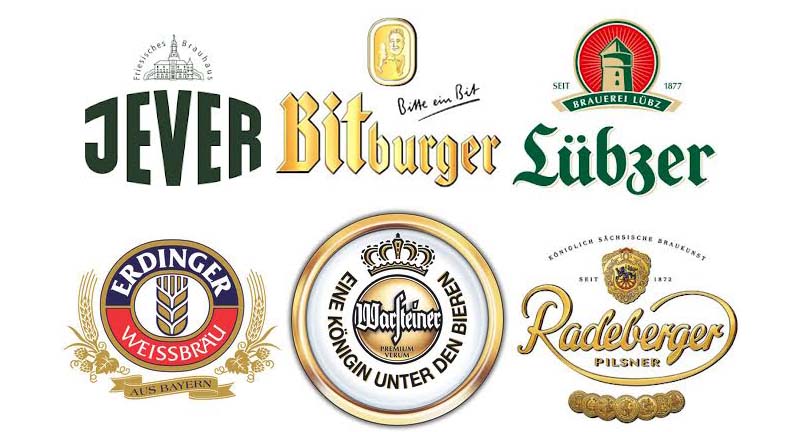 |
| Some of the names you'll see in Getränkeläden and Spätis. |
But here's the real kicker: Germany doesn't have a three-tier system to stop these conglomerates from vertically integrating, and thus controlling all steps in the process. For example, the Radeberger Group brews the beer from its 35+ brands, distributes them, and then sells them in warehouse-like Getränkeläden or Märkte (drink stores – see also my earlier post "Into the Drink"). This kind of vertical and horizontal integration has the positive effect of reduced production and distribution costs, such that beer is quite a bit cheaper than most water in Germany. I always thought it was just because Germany likes beer more than a friend, but it's really all about capitalism: the conglomerates can produce, distribute and sell beer extremely cheaply while still profiting, and want to keep it cheap, but not too cheap (either legally, or illegally by means of price collusion) to maintain their dominance. The end result, as Mr. Berges put it: "If you go to Getraenke Hoffmann (owned by Radeberger Group), they have 200 Getränkemärkte in Berlin and Brandenburg. And they all belong to this [Radeberger] Group. So if you go there and look at the variety, 50% comes from the same brewery. You do not see it because of all the different labels, the colors of the boxes, but it's all the same company...that is why people think it all tastes the same." The real clever bit on the part of the conglomerates was keeping all the regional labels they had swallowed up so that the vast majority of consumers would remain ignorant to the fact that all the variety is in fact illusory. I imagine most have no idea that their beloved local brand they grew up with has been bought out by a multinational corporation. In cities like Berlin, this means that the hundreds of small Spätis (convenience stores) can source all of their beer from two or three distributors (i.e. Radeberger, AB-InBev and BHI) and still offer what appears to be a wide selection of beers for rock-bottom prices. And the same goes for the supermarkets.
The Plight of the Beer-Lover's Beer Shop in Germany, and the Light at the End of the Tunnel
 |
| You'll have a clear sense of Germany's beer variety at Hopfen und Malz. (Photo: Philip Husemann) |
 |
| An IPA and a Märzen from Pax Bräu, one of Germany's new promising microbrews. (Photo: Philip Husemann) |
In the end, it's clear to me that there are two big keys to Germany (re)discovering the quality and variety of it's brewers: until shop owners like Berges have a less burdensome method of stocking products from quality, small-production breweries, they will remain needles in the haystack of Spätis, Getränkemärkte, and Supermärkte. The big players will definitely fight this tooth and nail, but I think craft brewers in the States and the new ones cropping up in Germany have shown that if you brew it, they will come. However, I think the demand side might be even more important: The German consumer must wake up, smell the hops, and realize that they've been duped by the beer behemoths. Nobody expects the majority to drop everything and never buy an AB-InBev beer again, but some of the energy Germans put into buying organic foods can certainly be shifted over to more conscientious beer shopping. Hopefully they can also overcome their often rigidly traditional mindsets to explore some of the plethora of wonderful beer types that didn't originate in or near Germany. I, for one, am optimistic.
 |
| Germans are still serious about brewing: give it a few years and Germany will also be crafting top-notch pales. (Photo: P. Husemann) |
(If you'd like to travel back in time to beer's past, have a look at Part 1. Also, another big thanks to Ludger Berges and Hopfen und Malz for his insight into this blog post. Also, if you're interested in getting updates on the newest promising pilsners, pale ales, and porters in Germany and beyond, the Hopfen und Malz Facebook feed is a great resource!)


